Proof

Two accounts, opened up.

Agency case studies are usually a logo and a percentage with no denominator. These are written the way I’d write yours up: what the situation was, what I found in the account, what I changed, and what I still don’t know.

Read them if you want the detail. If you’d rather just talk, book a call and we’ll go through your numbers together.

Aircon Cleaning SEQ

Split-system cleaning, South East Queensland · owner-operated

My own business
Situation

One person, part time, in a trade where every competitor advertises on price. Work came from word of mouth and the occasional boosted post — which meant good months and quiet months with no way to tell which was coming.

The temptation in a business like this is to buy volume: bid on “cheap aircon clean”, win the click, do the job for what it costs you. That’s a treadmill, not a business.

The lead engine

Facebook message ads pointed at homeowners in specific suburbs who were ready to book, with suburb landing pages behind them and Google Ads carrying the urgency offers.

Facebook message ads · April 2025 Off-peak season
Enquiries
167
message enquiries
Cost per enquiry
$13.60
all in
Ad spend
$2,270
$2,270.52 exactly
Booked
7–9
cleans a day

April is the month an aircon business is supposed to go quiet. That’s the point of showing this one rather than a January figure — anyone can fill a summer. The off-peak number is the one that tells you whether the marketing is doing the work or the weather is.

What it did to the books
28-day period vs the 28 days before it Solo operation
Revenue
$27,402
↑ 27% · was $21,530
Jobs completed
86
↑ 7.5% · was 80
Average job value
$319
↑ 19% · was $269
Staff
1
part time

Read the third column, not the first. Jobs went up 7.5%. Revenue went up 27%. Almost all of that gap is average job value moving $50. Volume is easy to buy — you just bid higher. A better class of job is the part that takes an account built on purpose, and it’s the part that’s still there when you stop spending.
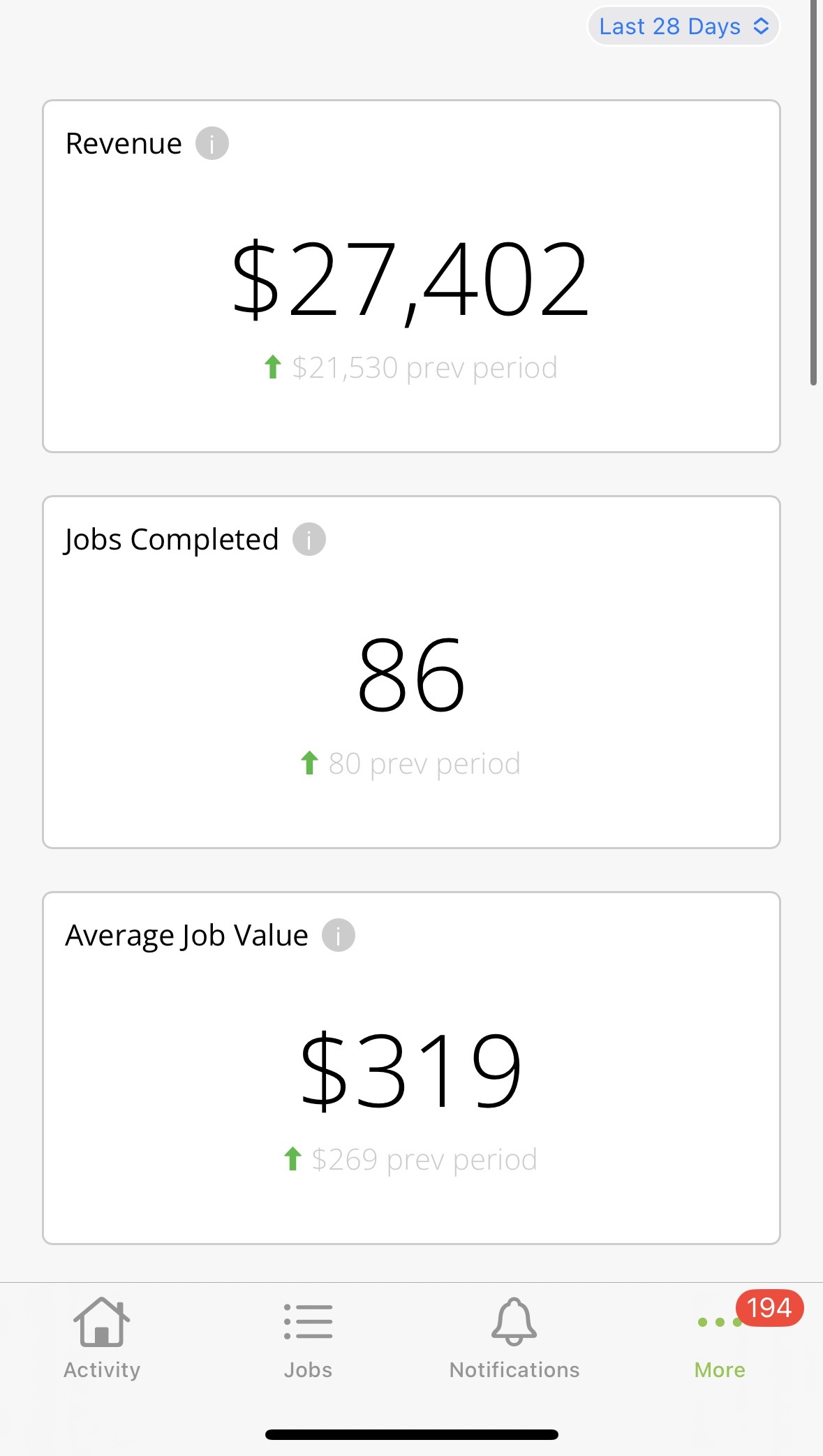
Aircon Cleaning SEQ booking dashboard showing 28-day revenue of $27,402 across 86 completed jobs
The dashboard the figures came off. Unedited.
The free half

Everything above is paid. This next part costs nothing, and over a full year it grew faster than anything I paid for. Google Business Profile, July 2026 against July 2025.

Google Business Profile July 2026 vs July 2025
Profile views
2,363
↑ 64.1%
Calls from profile
22
↑ 57.1%
Website clicks
135
↑ 19.5%
Interactions
161
↑ 26.8%

The searches that surfaced the profile are the honest version of a keyword report:

Search termTimes it showed the profile
aircon cleaning105
aircon cleaning brisbane53
air conditioner cleaning34
brisbane aircon servicing31
air con cleaning28

Note what isn’t there: nobody typed the business name. Every one of these is someone who needed the job done and didn’t know who to call yet.

One finding that will surprise you. 96% of those profile views came through Google Search — 1,132 desktop and 1,132 mobile, near enough to an even split. Only 4% came through Maps. Almost every trade owner I talk to assumes a Business Profile is a Maps thing and optimises it accordingly. It isn’t. It’s a search result, and it should be written like one.
Honest bit
$13.60 is a cost per enquiry, not a cost per booked job. Not every message becomes a clean, and I’m not going to imply it did. The three datasets above are also three different windows — April 2025 for the ads, a 28-day revenue snapshot, and July-on-July for the profile — so don’t read them as one continuous story. The profile numbers are the sturdiest of the three, because July against July holds the season constant on both sides. I’ll open any of the three dashboards on a call.
Want me to do that with yours? That is all a free check is. I go through the account myself — not a tool, not a template — and I write down what I find. You keep it whether you hire me or not. If I can’t do better than what you have already got, I’ll tell you that instead.

Case two

What I actually find when I look.

This is the better illustration of the free audit, because almost none of the problem was in the ad account. The ads were fine. Everything downstream of the click was quietly broken, and no report anywhere would have said so.

Declare the obvious first: this one is my family’s business, not an arm’s-length client. That makes it weaker evidence that people hire me, and stronger evidence of what a health check turns up — I had full access to the site, the ad account and the booking data, which is exactly the access I’d be asking you for. Read it as a worked example, not a reference.

Coral Car Rentals

Self-drive car hire, Nadi, Fiji · my family’s business, advertising to Australia

Family business
Situation

A small hire company running Facebook traffic ads at Australian holidaymakers. Spend was going out, clicks were coming in, and the enquiries reaching the inbox kept arriving half-finished — a name and an email, no dates, no vehicle. It looked like customers being lazy.

They weren’t. The site was doing it.

Found
  1. The spam trap was eating real customers. A hidden anti-bot field on the enquiry form was silently discarding legitimate submissions. No error, no message — the visitor pressed the button and the page sat there. Every one of those people assumed the business was broken and went to a competitor.
  2. Pressing “check availability” did nothing visible. When the page’s script didn’t run — old phone, patchy hotel wi-fi, a cached file — the form fell back to a plain page reload. The customer landed back where they started with no confirmation anything had happened.
  3. Completed bookings were destroying their own source data. A booking that arrived from a Facebook ad was recorded correctly at first touch, then overwritten with “Direct / unknown” when the customer finished the form. Which meant the channel report — the entire basis for deciding where the budget goes — was fiction.
  4. One enquiry, two records. No deduplication and no disabled submit button, so a double tap on a phone created two customers who didn’t exist.
  5. Pricing was typed into 64 pages by hand. Change the daily rate and you’re editing sixty-odd pages, or you miss some and the site quotes two different prices depending where the customer lands.
Fixed
  • Removed the trap killing submissions, and gave the form a real destination so it works even with the scripts dead
  • Built a reconciliation layer: an abandoned half-enquiry and the completed booking that follows it now merge into one record instead of two
  • First-touch attribution written once and never overwritten — so the channel report is something you can actually spend money on
  • Deduplication on identical submissions, and a submit button that can’t be double-fired
  • Every price replaced with a single reference. One change, sixty-four pages, no stragglers
  • A booking call-to-action that follows the visitor down the page, instead of one button in a corner that scrolls away
Then the ads

Only once the plumbing held did the advertising get touched. I pulled their strongest competitor’s ads out of Meta’s public library and read the campaign off it: Australia only, running continuously since October, and crucially a lead form that stays inside Facebook rather than a click through to a website.

Ten months of uninterrupted spend is worth paying attention to — it’s a strong hint that something in there is working, though plenty of businesses do keep funding a campaign that isn’t. Treat it as a lead worth testing, not proof of profitability. So we built a matched campaign to test that mechanic against their existing one, holding the brand voice steady so the only variable is the mechanic itself.

Honest bit
The campaign is days old and I’m not going to pretend otherwise. Early cost per lead is running well under the existing traffic campaign’s cost per visit, but that’s a handful of leads on a few dollars of spend and it will move. There’s no trustworthy verdict for a fortnight. What’s already banked is the repair: enquiries that used to vanish now arrive complete, and the channel report is true for the first time — all of that before a dollar of new ad spend. That’s the point I’d make about your account too.

Your turn

Most accounts I open have at least one of these in them.

Nothing recording it when someone enquires. A form that quietly loses people. A report full of numbers that never turn into jobs.

It costs nothing to have me look, and what I find is yours either way — even if you never speak to me again.

And if you’re not sure what you’re even looking at — that’s common, and it’s fine. Book a call and we’ll go through it together.

And what it costs afterwards is on the pricing page — no quote required, including the parts that will put some people off.